
Acupuncture: A Detailed History, Development, and Modern Understanding
Table of Contents
1.Executive summary
Acupuncture is a family of therapeutic practices in which specific areas of the body are stimulated—most commonly with thin, solid needles—to influence pain, physiology, and function. Its intellectual and clinical foundations developed in ancient China, but acupuncture was never a single, completely fixed system. It evolved through successive generations of physicians, medical texts, regional traditions, political movements, technological innovations, and cultural exchanges.
The most defensible historical conclusions are:
Acupuncture’s recognizable written foundations emerged approximately 2,000–2,300 years ago.
Earlier Chinese medicine included cauterization, moxibustion, bloodletting, massage, stone-lancet procedures, herbal medicine, ritual healing, and theories of vessels or pathways.
The Huangdi Neijing—the Yellow Emperor’s Inner Classic—is the foundational source for systematic acupuncture theory, but it was compiled by multiple authors over time rather than written by one person.
Acupuncture continued to change across the Han, Jin, Tang, Song, Ming, and Qing dynasties.
Distinct traditions developed in China, Korea, Japan, Vietnam, and later Europe and North America.
What is commonly called “Traditional Chinese Medicine,” or TCM, is partly ancient and partly a standardized modern synthesis developed in twentieth-century China.
Acupuncture’s American history did not begin with James Reston in 1971, although his widely read newspaper account created a major surge in mainstream attention.
Modern acupuncture now includes traditional channel-based treatment, microsystems, electroacupuncture, medical acupuncture, trigger-point approaches, scalp acupuncture, auricular acupuncture, and other specialized methods.
Contemporary research supports several plausible neurological, connective-tissue, circulatory, immune, and contextual mechanisms. No single mechanism explains every acupuncture effect.
Acupuncture is generally considered low risk when performed by a properly trained practitioner using sterile, single-use needles, although it is not risk-free. NCCIH
2. What is acupuncture?
In its narrowest modern definition, acupuncture is the insertion and manipulation of fine needles at selected body locations for therapeutic purposes. That definition, however, does not fully describe the historical practice.
Classical East Asian acupuncture may involve:
Selection of points according to channel and collateral theory
Local, adjacent, and distal point combinations
Pattern differentiation
Pulse and tongue assessment
Manual needle manipulation
Tonifying and reducing techniques
Moxibustion
Bloodletting
Cupping
Gua sha
Plum-blossom or seven-star needling
Intradermal or press needles
Auricular treatment
Scalp acupuncture
Electroacupuncture
Heat, pressure, light, or electrical stimulation of acupuncture points
The Chinese word commonly translated as acupuncture, zhenjiu (針灸 or 针灸), literally joins two therapies:
Zhen: needling
Jiu: moxibustion or cauterization
Historically, needling and moxibustion were closely related. Translating zhenjiu simply as “acupuncture” can therefore understate the importance of heat therapy in early Chinese medicine.
3. The problem of identifying a single “origin”
Popular accounts often say acupuncture is 3,000, 4,000, or even 5,000 years old. Those statements are difficult to prove.
There are three different questions that are frequently blended together:
When did people first pierce, lance, cauterize, or stimulate the body therapeutically?
When did Chinese physicians begin describing vessels or pathways?
When did a recognizable acupuncture system—with named points, channels, diagnostic theories, and defined needle techniques—emerge?
Human beings probably used sharp stones, bones, heat, pressure, and primitive surgical instruments long before written medicine. That does not necessarily mean those procedures were acupuncture.
-
Ancient Chinese sources refer to bian shi: sharpened stones used for lancing, draining abscesses, bloodletting, or stimulating the body. They are sometimes described as the earliest acupuncture needles.
This is possible as part of acupuncture’s technological ancestry, but a bian stone was not necessarily used like a modern filiform needle. Many were probably minor surgical or bloodletting instruments. It is safer to say that these tools belonged to the broader therapeutic environment from which needling medicine eventually developed.
-
Ötzi, a roughly 5,300-year-old European mummy, has tattoos near areas that resemble some later acupuncture locations. This is sometimes presented as proof of prehistoric acupuncture.
The markings are intriguing, but they do not establish that acupuncture existed in Neolithic Europe or that the tattoos were placed according to Chinese channel theory. They may have been therapeutic, symbolic, decorative, or used for another unknown purpose. They should be regarded as suggestive evidence of ancient body stimulation—not proof of acupuncture.
4. Early Chinese healing before classical acupuncture
Before systematic acupuncture appeared, Chinese healing included overlapping religious, empirical, environmental, and naturalistic ideas.
Illness could be understood in terms of:
Ancestral or spiritual influences
Demonic or pathogenic invasion
Injury and warfare
Seasonal and climatic exposure
Diet and lifestyle
Emotional disruption
Internal disharmony
Obstruction or abnormal movement within the body
Weakness, depletion, excess, heat, cold, dampness, or dryness
Over time, Chinese medicine increasingly explained disease through observable patterns and relationships rather than solely through supernatural causes.
Important concepts included:
Qi: activity, influence, breath, function, or vital movement
Xue: blood
Jing: essence
Shen: spirit, awareness, or integrative mental activity
Yin and yang
The Five Phases
Zang-fu organ systems
Vessels, channels, and collaterals
Correspondence between the human body and the natural environment
These concepts did not all appear simultaneously. They accumulated and were repeatedly reorganized.
5. The earliest channel manuscripts
One of the most important archaeological discoveries in the history of Chinese medicine occurred at Mawangdui, near Changsha. Tombs sealed in 168 BCE were excavated during the 1970s and contained medical manuscripts representing traditions older than the classical form of the Huangdi Neijing.
The Mawangdui manuscripts describe eleven vessels or pathways rather than the later twelve primary channels. They associate the pathways with symptoms and discuss treatment, particularly moxibustion. They do not present the mature network of acupuncture points found in later texts.
That distinction is important:
Early vessel theory existed before the fully developed acupuncture-point system.
Channels may not originally have been conceived exactly as they are in later TCM.
Moxibustion appears to have had an especially important early role.
The point system and channel system likely developed gradually rather than appearing together in complete form.
Scholarly examinations of these manuscripts note that they contain channels but no fully developed acupuncture-point system. Bangor University research summary
6. The Huangdi Neijing
The Huangdi Neijing, or Yellow Emperor’s Inner Classic, is the foundational work of classical Chinese medical theory.
It is traditionally presented as a dialogue between the legendary Yellow Emperor, Huangdi, and medical advisers, especially Qibo. Huangdi was not its literal author. The text is a compilation produced by multiple intellectual and medical traditions.
Its material was probably assembled and edited over several centuries, with much of its formation occurring during the late Warring States and Han periods. Dating individual passages remains debated.
-
Suwen—“Basic Questions”
Lingshu—often translated as “Spiritual Pivot” or “Divine Pivot”
The Suwen emphasizes physiology, cosmology, diagnosis, disease, seasonal health, and treatment principles. The Lingshu is especially important to acupuncture because it discusses channels, points, needling methods, needle types, depth, timing, indications, and the movement of qi and blood.
The Neijing helped establish several enduring principles:
Health depends on dynamic regulation rather than a static state.
Symptoms must be interpreted in relation to the whole person.
Location alone does not determine treatment.
External disease may penetrate from superficial to deeper levels.
Internal organs function within interdependent networks.
Treatment should account for constitution, season, environment, age, and disease stage.
Needle technique matters as much as point selection.
Distal points may treat symptoms far from the needle.
The therapeutic response is more important than merely placing a needle at a named location.
A recent historical-anatomical analysis describes the Neijing as the earliest surviving text to present acupuncture in a developed medical framework, while also emphasizing its composite nature. PubMed Central
-
The Lingshu describes nine classical needles. They were not all thin filiform needles. The collection included instruments resembling:
Lancets
Blunt pressure tools
Rounded massage instruments
Larger puncturing needles
Long needles
Fine filiform needles
This tells us that ancient zhen therapy included a wider range of procedures than modern acupuncture. Some methods bordered on bloodletting, minor surgery, drainage, pressure therapy, and deep tissue stimulation.
7. The Han dynasty: formation of a medical system
The Han dynasty, 206 BCE–220 CE, was one of the most important formative periods in Chinese medicine.
During this era:
Yin-yang and Five Phase frameworks became more systematically integrated into medicine.
Vessel theories developed into more complex channel networks.
Relationships between channels, internal organs, symptoms, and therapeutic locations were refined.
Acupuncture, moxibustion, herbs, exercise, diet, and lifestyle medicine became parts of a broader medical system.
Medical knowledge increasingly circulated through texts and scholarly lineages.
-
The Nanjing, or Classic of Difficult Issues, probably took shape around the late Han period. It addresses difficult or ambiguous questions arising from earlier medical theory.
Its contributions include:
Pulse diagnosis
Five Phase relationships
Organ-system theory
Channel circulation
Extraordinary vessels
Source points
Influential point-selection principles
The Nanjing helped turn the diffuse material of early medicine into a more coherent clinical system.
-
Zhang Zhongjing, traditionally dated to approximately 150–219 CE, is most famous for the Shang Han Za Bing Lun, the Treatise on Cold Damage and Miscellaneous Diseases.
His work is more closely associated with herbal medicine than acupuncture, but it profoundly shaped Chinese clinical reasoning. It emphasized:
Disease progression
Pattern differentiation
Treatment based on the patient’s presentation rather than solely on a disease name
Relationships among external pathogens, internal function, strength, and constitutional vulnerability
This pattern-based reasoning became inseparable from later acupuncture practice.
8. Huangfu Mi and the first major acupuncture compilation
During the third century CE, Huangfu Mi compiled the Zhenjiu Jiayi Jing, generally translated as the Systematic Classic of Acupuncture and Moxibustion.
This was a landmark because it:
Organized earlier material from the Neijing and related sources
Systematized channel and point information
Described point locations and indications
Discussed needling depth and moxibustion
Helped establish acupuncture as a distinct scholarly specialty
Preserved material that might otherwise have been lost
The work is traditionally associated with 349 acupuncture points, fewer than the later standardized 361 classical points.
Huangfu Mi did not invent acupuncture. His importance lies in collecting, clarifying, and organizing a medical tradition that had already been developing for centuries.
9. Acupuncture during the Sui and Tang dynasties
The Sui dynasty, 581–618, and Tang dynasty, 618–907, were periods of cultural expansion and international exchange.
Chinese medicine became more institutionally organized. Medical education and government examinations developed, and acupuncture was taught as a recognized medical specialty.
-
Sun Simiao, approximately 581–682, was one of China’s most influential physicians. His works included the Qianjin Yaofang, often translated as Essential Prescriptions Worth a Thousand Gold Pieces.
His contributions included:
Integrating acupuncture, moxibustion, herbs, diet, exercise, and lifestyle
Emphasizing medical ethics
Describing ashi points—tender or reactive locations used therapeutically
Discussing preventive medicine and cultivation of health
Adapting treatment to the individual
The concept of an ashi point is historically important because it shows that acupuncture was never restricted to fixed textbook locations. Palpation and responsiveness remained essential.
-
Chinese medicine traveled through diplomatic, religious, educational, and commercial exchange.
By the first millennium CE, acupuncture-related knowledge had reached:
Korea
Japan
Vietnam
Other parts of East and Central Asia
These regions did not merely copy Chinese medicine. They developed their own diagnostic preferences, techniques, tools, educational systems, and classical interpretations.
10. The Song dynasty: standardization and the Bronze Man
The Song dynasty, 960–1279, placed great emphasis on scholarship, printing, administration, and standardization.
In 1026, physician Wang Weiyi produced an important standardized acupuncture text and supervised the construction of life-size bronze anatomical teaching figures.
These “Bronze Men” reportedly contained:
Marked channels and acupuncture points
Holes at point locations
Internal anatomical representations
A wax coating used during examinations
Liquid inside the model that would leak when a student correctly needled a point
Whether every traditional detail about the examinations occurred exactly as later described is less important than the broader significance: acupuncture was becoming formally mapped, taught, examined, and regulated.
Printing technology also allowed medical texts to circulate more widely, reducing dependence on isolated oral lineages.
11. Jin–Yuan medical innovation
During the Jin and Yuan periods, roughly the twelfth through fourteenth centuries, Chinese medicine underwent major theoretical diversification.
The “Four Great Masters” developed different explanations for disease:
Liu Wansu emphasized fire and heat.
Zhang Congzheng emphasized attacking or expelling pathogenic factors.
Li Gao emphasized the spleen, stomach, and internal damage.
Zhu Danxi emphasized ministerial fire and yin deficiency.
These physicians are better known for internal medicine and herbal theory, but their work affected acupuncture by strengthening the idea that a symptom can arise through different mechanisms.
For example, pain could be understood through:
Cold
Heat
Blood stasis
Qi stagnation
Dampness
Phlegm
Deficiency
External injury
Organ-system dysfunction
Channel obstruction
This is a core reason classical acupuncture does not rely exclusively on symptom-based point prescriptions.
12. The Ming dynasty and the Great Compendium
The Ming dynasty, 1368–1644, produced one of acupuncture’s most influential texts: Yang Jizhou’s Zhenjiu Dacheng, or Great Compendium of Acupuncture and Moxibustion, published in 1601.
The work synthesized material from earlier texts and lineages, including:
Channel theory
Point locations
Point indications
Needling methods
Moxibustion
Five Shu points
Source and connecting points
Eight extraordinary vessel methods
Time-based point selection
Clinical case material
Songs and memorization verses
The Great Compendium helped preserve acupuncture at a time when different schools used somewhat different point locations, theories, and techniques.
By the Ming period, recognizable forms of the 14-channel and 361-point system had become strongly established, although extra points and lineage-specific locations remained important.
13. Acupuncture in Korea
Chinese medical literature entered Korea over many centuries, but Korean physicians developed distinctive traditions.
Important features include:
Adaptation of Chinese classical medicine to Korean conditions
Strong integration of acupuncture and herbal medicine
Constitutional approaches
Development of specialized techniques
Saam acupuncture
Korean hand acupuncture in the modern era
-
Heo Jun’s Dongui Bogam, completed in 1610 and published in 1613, became one of Korea’s most important medical texts. It organized internal medicine, external disorders, herbs, acupuncture, and health cultivation into a practical clinical system.
-
Saam acupuncture is traditionally associated with a Korean Buddhist monk and is generally placed in the seventeenth century, although the biography and exact history are uncertain.
It uses Five Phase relationships and typically combines points to tonify or sedate channel systems. Its elegance lies in treating channel relationships through compact distal prescriptions.
14. Acupuncture in Japan
Chinese medicine reached Japan through Korea and direct contact with China. Japanese acupuncture developed distinctive features, particularly in palpation, needle refinement, and gentle technique.
-
Waichi Sugiyama, 1610–1694, was a blind Japanese acupuncturist traditionally credited with developing or popularizing the guide tube.
The guide tube allowed:
Faster skin penetration
Greater control
Reduced insertion discomfort
Use of thinner needles
This was an important technical step toward modern Japanese and international filiform needling.
-
Meridian therapy
Abdominal diagnosis
Highly refined palpation
Shallow needling
Contact needling
Pediatric noninsertion techniques such as shonishin
Specialized moxibustion
Strong professional traditions among blind practitioners
Japanese acupuncture demonstrates that effective acupuncture practice need not depend on deep or forceful stimulation.
15. Decline and controversy during the Qing dynasty
During the Qing dynasty, 1644–1912, acupuncture continued in popular and private practice but lost some status within elite institutional medicine.
Several factors may have contributed:
Increasing prestige of herbal medicine among scholarly physicians
Concern about invasive procedures
Uneven training and technique
Changing medical institutions
Political and intellectual interest in Western science
Association of manual procedures with lower-status practitioners
In 1822, acupuncture and moxibustion were removed from the curriculum of the Imperial Medical Institute. This did not ban acupuncture throughout China, but it illustrates a decline in its official status.
This period corrects a common misconception: acupuncture did not enjoy uninterrupted prestige merely because it was ancient. Its status rose, fell, and changed repeatedly.
16. The arrival of acupuncture in Europe
European contact with East Asian acupuncture increased through missionaries, merchants, physicians, colonial networks, and the Dutch East India Company.
-
Dutch physician Willem ten Rhijne observed Japanese medicine while stationed in Japan. In 1683, he published De Acupunctura, one of the first detailed European accounts of acupuncture.
The Latin term acupunctura combines ideas of:
Acus: needle
Punctura: puncture
His work helped establish the European term “acupuncture,” although his interpretation of East Asian medical theory was limited by language, cultural barriers, and European anatomical assumptions. His 1683 publication is widely recognized as the first detailed Western treatise on the subject. University of Pittsburgh Health Sciences Library
-
European physicians experimented with needling for:
Musculoskeletal pain
Rheumatism
Neuralgia
Gout
Spasm
Paralysis
Other painful disorders
French physician Louis Berlioz published on acupuncture in the early nineteenth century. Other French and British physicians subsequently experimented with the technique.
Many European doctors stripped acupuncture of its traditional diagnostic framework and treated it as a local physical stimulus. This foreshadowed the later division between:
Traditional East Asian acupuncture
Western medical acupuncture
Trigger-point needling
Neuroanatomical needling
17. Acupuncture in the United States before 1971
Acupuncture did not suddenly arrive in America in 1971.
It was present through:
Chinese immigrant communities
Asian American medical practitioners
European medical literature
Nineteenth-century physician experimentation
Informal family and community transmission
In the nineteenth century, American physicians published reports of acupuncture experiments, often using it for pain. Franklin Bache, a physician and great-grandson of Benjamin Franklin, published an account of acupuncture experimentation in 1826.
Later editions of William Osler’s Principles and Practice of Medicine mentioned needling for conditions such as lumbago, illustrating that the technique was known within Western medicine even when it was not widely practiced.
Chinese practitioners, however, often worked under discriminatory laws and social conditions. Their role in American medical history was subsequently minimized. Chinese exclusion, anti-Asian prejudice, and restrictive medical licensing all affected the public visibility of Chinese medicine.
18. Republican China and the struggle over “old medicine”
After the fall of the Qing dynasty in 1912, Chinese medicine entered a period of intense debate.
Reformers asked whether China should:
Preserve classical medicine
Abandon it in favor of Western biomedicine
Scientifically reinterpret it
Combine Chinese and Western approaches
Separate useful clinical techniques from traditional theory
In 1929, a proposal was advanced to restrict or abolish what was called “old medicine.” Chinese medicine practitioners organized politically and successfully resisted the proposal.
This episode was crucial. It encouraged practitioners to:
Form professional associations
Standardize education
Publish journals
Defend Chinese medicine using scientific and nationalist language
Present their work as a coherent medical system
Modern Chinese medicine grew partly from this struggle for survival.
19. Acupuncture under the People’s Republic of China
After 1949, the new Chinese government faced severe shortages of health care personnel and resources.
The government eventually supported the integration of Chinese and Western medicine, but the process was selective and politically shaped.
Chinese medicine was:
Institutionalized in colleges and hospitals
Standardized into textbooks
Reorganized into defined diagnostic categories
Studied using biomedical methods
Promoted as a national cultural and medical resource
Made more uniform across regions
-
“Traditional Chinese Medicine” should not be understood as an unchanged medical system handed down intact from antiquity.
Modern TCM drew from ancient and premodern sources, but twentieth-century institutions:
Selected preferred theories
Combined material from different lineages
Regularized terminology
Standardized point locations
Created teachable diagnostic frameworks
Reduced some religious and cosmological material
Emphasized compatibility with modern science
Established formal curricula and examinations
TCM is therefore both traditional and modern: it preserves ancient principles through a twentieth-century institutional structure.
-
During the 1960s and 1970s, “barefoot doctors” provided basic health care in rural China. Their work might include:
Public health education
Sanitation
Basic medications
Vaccination
First aid
Herbal medicine
Acupuncture
Their training was far shorter than that of classical physicians or modern licensed acupuncturists. They were important to rural health policy, but they should not be treated as representative of the full depth of Chinese medical education.
20. Acupuncture anesthesia
Acupuncture anesthesia became internationally famous during the twentieth century, particularly during the Cultural Revolution.
In selected operations, patients received acupuncture or electroacupuncture as part of an analgesic protocol. Public demonstrations sometimes implied that acupuncture alone replaced conventional anesthesia for major surgery.
The reality was more complicated:
Patients were carefully selected.
Sedatives, local anesthetics, analgesics, or other medications were often used.
Psychological preparation was extensive.
Acupuncture analgesia was variable.
The method was unsuitable as a universal replacement for anesthesia.
Its historical importance was nevertheless considerable. It encouraged research into:
Endogenous opioids
Descending pain inhibition
Segmental modulation
Electroacupuncture frequency
Central nervous system responses
21. James Reston and the American turning point
In 1971, New York Times journalist James Reston underwent an appendectomy while visiting China.
A frequent retelling says that his surgery was performed under acupuncture anesthesia. That is incorrect. He received conventional anesthesia for the operation. Acupuncture was subsequently used for postoperative pain and abdominal distention.
Reston wrote about the experience in a prominent article, helping ignite widespread American interest at the same time the United States was reopening diplomatic relations with China. The University of Illinois archive preserves material documenting the episode and its public impact. University of Illinois Archives
Reston did not introduce acupuncture to America. His influence came from making it highly visible to a mainstream national audience.
22. Community acupuncture and political activism
An often-overlooked chapter of American acupuncture history occurred in activist health clinics during the 1970s.
At Lincoln Hospital in the Bronx, members of the Young Lords, Black Panthers, and other community activists became involved in drug-treatment programs. The resulting Lincoln Detox movement developed an auricular acupuncture protocol as part of care for withdrawal and recovery.
This history matters because it places American acupuncture not only in private clinics and academic medicine, but also in:
Civil rights activism
Community-controlled health care
Addiction treatment
Public-health reform
Efforts to address unequal access to care
The later National Acupuncture Detoxification Association, or NADA, developed a standardized five-point ear protocol influenced by this work.
23. Legalization and professionalization in America
During the early 1970s, states began creating laws that allowed or regulated acupuncture practice by nonphysician practitioners.
California became the eighth state to license acupuncturists in 1976. In 1978, California eliminated a prior-referral requirement and recognized acupuncture as a primary health care profession. California Acupuncture Board
Professionalization gradually included:
State practice acts
Licensing boards
Accredited schools
National examinations
Clean Needle Technique requirements
Defined scopes of practice
Continuing education
Malpractice standards
Professional associations
Regulation remains state-based, so scope, titles, supervision rules, and permitted adjunctive therapies differ across the country.
FDA regulation
Acupuncture needles were initially treated in the United States as investigational devices. They were later regulated as Class II medical devices. Modern needles marketed for general acupuncture practice are prescription devices intended for use by qualified practitioners and are ordinarily sterile and single use. FDA device record
This change helped move acupuncture from an “experimental device” framework toward routine professional practice.
24. The 1997 NIH consensus conference
The 1997 NIH Consensus Development Conference was a landmark in American acupuncture research.
The panel concluded that evidence was promising for certain uses, particularly:
Adult postoperative nausea and vomiting
Chemotherapy-related nausea and vomiting
Postoperative dental pain
It also identified conditions in which acupuncture might be useful as an adjunct or component of a broader treatment program, while emphasizing methodological limitations.
The statement was not a declaration that acupuncture had been proven effective for every condition. Its historical importance was that a major American scientific institution publicly recognized acupuncture as worthy of clinical use and serious investigation. NIH consensus statement record
25. International standardization
As acupuncture spread worldwide, point names and locations varied among Chinese, Japanese, Korean, Vietnamese, and Western systems.
The World Health Organization supported efforts to standardize:
Channel abbreviations
Alphanumeric point codes
Pinyin names
Classical point locations
Technical terminology
The standard international system included the familiar 14 channels and 361 classical acupuncture points, while also recognizing extra points and specialized systems. WHO standard nomenclature
WHO subsequently published safety, practice, and educational benchmarks. Its current benchmark documents are intended as international reference points, not substitutes for individual national or state licensing laws. WHO training benchmarks and WHO practice benchmarks
26. Major modern acupuncture traditions
Modern acupuncture is better understood as a family of related systems.
-
Commonly emphasizes:
Zang-fu pattern differentiation
Tongue and pulse diagnosis
Channel theory
Local and distal points
Standardized point functions
Manual needling and deqi
Integration with herbal medicine and other modalities
-
This broad label is used in different ways. It may refer to systems that emphasize:
Direct study of classical texts
Six-stage or channel-based diagnosis
Five Phase relationships
Extraordinary vessels
Classical needle methods
Individualized point combinations
It should not be assumed that everyone using the term “classical” practices the same system.
-
Modern Five Element practice developed primarily through twentieth-century interpretations associated with figures such as J.R. Worsley.
It often emphasizes:
Constitutional patterns
Emotional and spiritual dimensions
Color, sound, odor, and emotion
Elemental relationships
Treatment of a constitutional factor
It draws from classical Five Phase theory but is a distinct modern school.
-
Often emphasizes:
Palpation
Abdominal diagnosis
Subtle pulse assessment
Shallow insertion
Fine needles
Gentle stimulation
Root and branch treatment
Moxibustion
-
Includes:
Saam acupuncture
Constitutional medicine
Korean hand acupuncture
Five Phase-based distal strategies
-
French physicians and scholars helped develop European interpretations of channel and energetic theory. French-language translations strongly influenced early Western acupuncture education.
-
Usually practiced by biomedical professionals and often explained through:
Neuroanatomy
Segmental innervation
Peripheral nerve stimulation
Trigger points
Central pain modulation
Training and theory vary considerably.
-
Electrical stimulation is applied between inserted needles. It has been important in both clinical practice and laboratory research because parameters such as frequency, intensity, and duration can be controlled.
-
Modern scalp acupuncture emerged during the twentieth century. It combines needling of scalp zones with neurological or functional representations and is often used in rehabilitation-oriented settings.
-
Ear treatment has ancient precedents, but the modern somatotopic ear system was strongly influenced by French physician Paul Nogier in the 1950s. Chinese and Western auricular systems subsequently influenced one another.
-
Trigger-point needling and dry needling overlap technically with some forms of acupuncture, particularly ashi, motor-point, and myofascial treatment.
The modern professional distinction usually rests on:
Diagnostic framework
Training
scope-of-practice law
point-selection rationale
professional identity
Historically and technically, the boundary is not always clean.
27. How classical acupuncture explains its effects
Classical Chinese medicine describes acupuncture through functional relationships.
-
Pain and dysfunction may arise when qi and blood:
Fail to move
Move in the wrong direction
Become deficient
Accumulate
Lose coordination
Fail to nourish tissues
The statement “where there is free flow, there is no pain” summarizes one influential classical idea, although not all pain is attributed solely to stagnation.
-
Channels connect:
Surface and interior
Upper and lower body
Limbs and trunk
Sensory structures and internal systems
Local symptoms and distant treatment areas
Channels should not automatically be equated with nerves, blood vessels, lymphatics, or fascial planes. They are functional maps created within a different medical framework. Certain channel pathways may correspond partly with known anatomy, but no single tissue structure explains the entire channel system.
-
The branch is the visible symptom. The root is the deeper pattern that allows the symptom to develop or persist.
A treatment may therefore combine:
Local symptom relief
Distal channel regulation
Constitutional support
Correction of an underlying pattern
Prevention of recurrence
-
Classical needle technique can be used to:
Strengthen deficient function
Reduce excess activity
Move stagnation
Warm cold
Clear heat
Redirect abnormal movement
Harmonize interacting systems
These terms belong to the classical functional model and should not be translated too literally into isolated biomedical actions
28. Modern physiological explanations
Modern research does not support the idea that acupuncture operates through one universal mechanism. Different effects likely involve different combinations of peripheral stimulation, spinal processing, brain networks, connective tissue, circulation, immune signaling, and treatment context.
-
Needling can stimulate:
A-delta fibers
C fibers
Mechanoreceptors
Polymodal nociceptors
Muscle afferents
Connective-tissue sensory structures
The resulting afferent input may alter processing locally, in the spinal cord, and in the brain.
-
Needling near the same spinal segment as a painful region may influence nociceptive processing within the dorsal horn.
This can affect:
Pain transmission
Muscle tone
Protective guarding
Referred pain patterns
Autonomic responses
-
Acupuncture can engage brainstem and higher-brain networks involved in descending pain regulation.
These systems can influence spinal nociceptive transmission through neurotransmitters such as:
Endogenous opioids
Serotonin
Norepinephrine
GABA
Other neuromodulators
-
Research, particularly involving electroacupuncture, helped demonstrate roles for:
Endorphins
Enkephalins
Dynorphins
Different stimulation frequencies may preferentially affect different opioid systems, although clinical responses are more complex than a simple frequency formula.
-
Imaging studies suggest acupuncture can influence networks associated with:
Pain perception
Salience
attention
emotion
expectation
autonomic regulation
sensorimotor processing
These findings do not mean a single brain image proves acupuncture’s clinical effectiveness. They indicate that needling can produce measurable central nervous system responses.
-
Acupuncture may affect sympathetic and parasympathetic activity. Proposed pathways include:
Somato-autonomic reflexes
Brainstem regulation
Vagal-adrenal pathways
Changes in heart-rate variability
Effects on gastrointestinal motility and vascular tone
The direction of the response may depend on point location, intensity, baseline condition, and treatment context.
-
Needle insertion may produce localized changes involving:
Adenosine
Nitric oxide
Neuropeptides
Mast cells
Cytokines
Microcirculation
Local inflammatory signaling
These changes may help explain why local needling can influence pain and tissue sensitivity.
-
Manual needle rotation can wind connective tissue around the needle. This can create mechanical signaling among fibroblasts, extracellular matrix, sensory nerves, and local tissues.
This does not prove that channels are identical to fascial planes. It does provide a plausible mechanism by which needle manipulation may influence a wider tissue region than the needle shaft alone.
-
Acupuncture treatment also includes clinically meaningful contextual elements:
Practitioner-patient interaction
Expectation
Previous experience
Ritual
relaxation
focused attention
therapeutic touch
time spent being assessed and treated
These influences are real components of clinical outcomes. They do not automatically mean that acupuncture is “only placebo.” Research attempts to determine how much benefit comes from point selection and needle stimulation versus these broader treatment effects.
NCCIH notes both the evidence of benefit for some pain conditions and the difficulty of separating specific needling effects from nonspecific effects in clinical trials. NCCIH
29. Challenges in acupuncture research
Acupuncture is unusually difficult to study using a conventional drug-trial model.
-
A sham procedure may involve:
Superficial needling
Needling at nonclassical points
Nonpenetrating devices
Needling away from the intended region
Minimal stimulation
Each can still produce sensory, neurological, circulatory, or contextual effects. Consequently, a small difference between real and sham acupuncture does not necessarily mean the treatment is ineffective. It may mean the control produced an active physiological response
-
Clinical outcomes may depend on:
Practitioner skill
Diagnosis
point selection
depth
angle
manipulation
treatment frequency
number of sessions
retention time
electrical stimulation
patient constitution
duration and severity of illness
A trial using six standardized points for every participant is not equivalent to individualized clinical practice.
-
Explanatory trials ask whether a specific needling method outperforms a tightly controlled sham.
Pragmatic trials ask whether adding acupuncture to real-world care improves outcomes compared with usual care.
Both are useful, but they answer different questions.
30. Present clinical position
The modern evidence base is strongest for certain pain-related and symptom-management applications, although the certainty and magnitude of benefit vary by condition.
Acupuncture is commonly investigated or used for:
Chronic low-back pain
Neck pain
Osteoarthritis pain
Headache and migraine prevention
Myofascial pain
Postoperative nausea
Chemotherapy-related nausea
Certain rehabilitation goals
Stress-related symptoms
Sleep disturbance
Other chronic pain presentations
It should not be represented as proven to cure every disease historically associated with an acupuncture point or pattern.
NCCIH currently describes acupuncture as having been used in some form for at least 2,500 years and reports that American adult use more than doubled between 2002 and 2022—from 1.0% to 2.2%. NCCIH
31. Safety and the development of Clean Needle Technique
Historical acupuncture did not possess modern germ theory, sterilization, disposable needles, or contemporary anatomical safety standards.
Modern safety improved through:
Single-use sterile needles
Hand hygiene
Skin preparation standards
Sharps containers
Bloodborne-pathogen precautions
Anatomical training
Defined depth and angle precautions
Licensing and professional education
Adverse-event reporting
Common minor reactions can include:
Brief discomfort
Minor bleeding
Bruising
Temporary soreness
Lightheadedness
Fatigue
Uncommon but potentially serious complications include:
Pneumothorax
Organ injury
Infection
nerve injury
retained or broken needles
syncope-related injury
Serious complications are considered uncommon when acupuncture is performed appropriately, but safe practice depends heavily on practitioner training, anatomical knowledge, clean technique, and correct needle handling. NCCIH safety overview
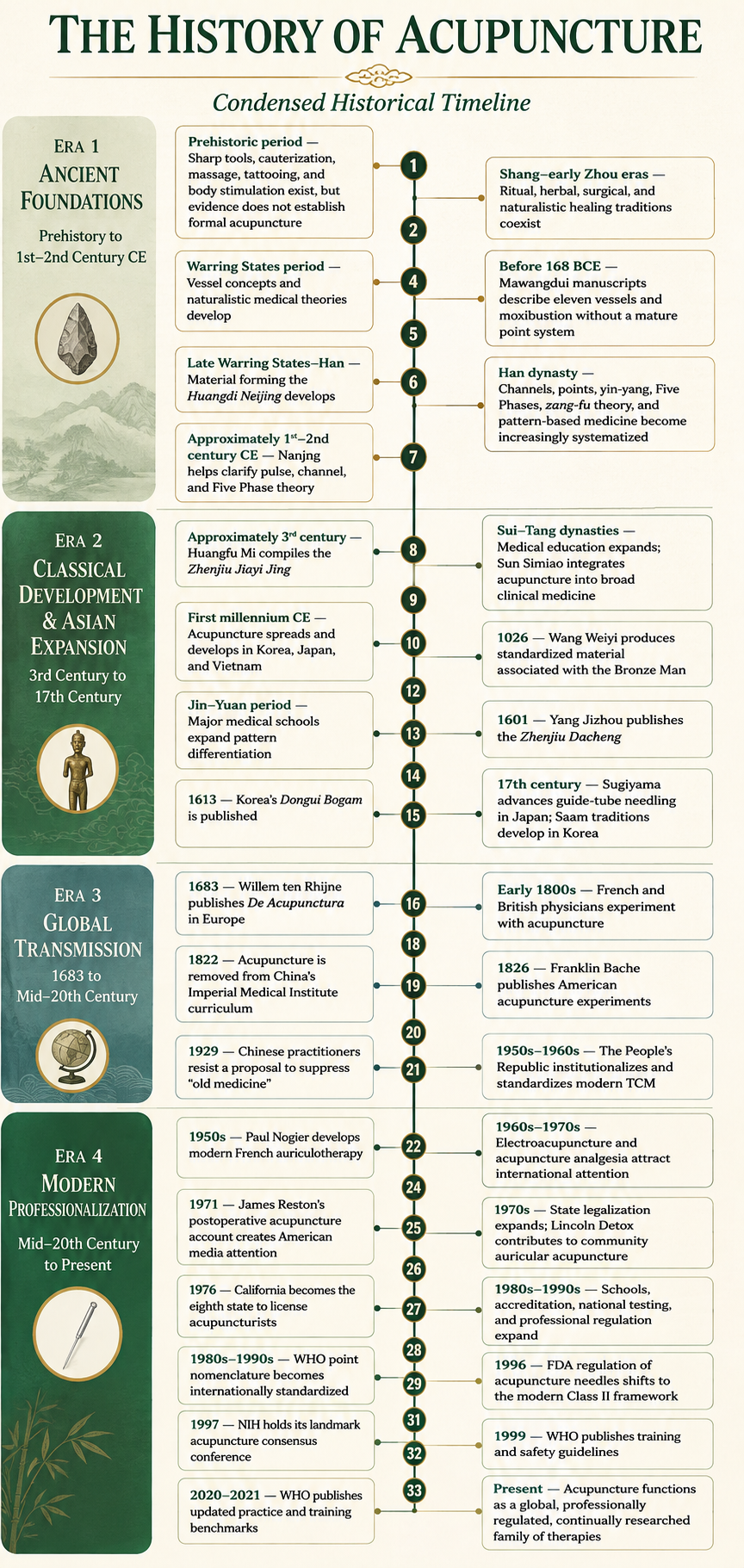
33. Conclusion
Acupuncture is neither an unchanged relic nor a recently invented alternative treatment. It is a living medical tradition formed through more than two millennia of observation, textual scholarship, clinical experimentation, cultural exchange, political conflict, and technological development.
Its oldest recognizable foundations emerged when early Chinese vessel theories, moxibustion, needling, naturalistic physiology, and pattern-based diagnosis were organized into the medical literature represented by the Huangdi Neijing. Successive physicians refined the system, while Korea, Japan, Vietnam, Europe, and North America created their own interpretations.
Modern acupuncture retains concepts such as qi, blood, channels, root and branch, and pattern differentiation, but it now also operates within contemporary systems of anatomy, neurophysiology, sterile procedure, regulation, clinical research, and integrative care.
Perhaps the most historically accurate way to understand acupuncture is not as one technique or theory, but as an evolving therapeutic discipline: ancient in foundation, diverse in practice, and still developing.
34. References and Further Reading
-
These are modern translations or scholarly studies of the classical sources discussed in the report.
Huangfu Mi. (1994). The Systematic Classic of Acupuncture and Moxibustion. Translated by Yang Shou-zhong and Charles Chace. Blue Poppy Press.
A major third-century compilation that organized point locations, indications, needle depths, moxibustion practices, and material from the Huangdi Neijing.Huangdi. (2002). Huang Di Nei Jing Su Wen: Nature, Knowledge, Imagery in an Ancient Chinese Medical Text. Translated and analyzed by Paul U. Unschuld. University of California Press. University of California Press
Huangdi. (2011). Huang Di Nei Jing Ling Shu: The Ancient Classic on Needle Therapy. Translated by Paul U. Unschuld. University of California Press.
One of the most valuable English-language scholarly translations of the acupuncture-focused portion of the Neijing.Nan Jing College of Traditional Chinese Medicine. (1999). Chinese Acupuncture and Moxibustion. Foreign Languages Press.
A modern standardized presentation of TCM acupuncture theory, point locations, techniques, and clinical applications.Sun Simiao. (2007–2013). Essential Prescriptions Worth a Thousand Gold for Emergencies. Selected translations by Sabine Wilms. Chinese Medicine Database.
Provides insight into Tang-dynasty medicine, medical ethics, prevention, acupuncture, moxibustion, diet, and integrated treatment.Yang Jizhou. (1987). The Great Compendium of Acupuncture and Moxibustion: Zhen Jiu Da Cheng. Translated by Lorraine Wilcox. Chinese Medicine Database.
A translation of the influential Ming-dynasty acupuncture compilation originally published in 1601.
Early Chinese medicine and archaeological history
Harper, D. (1998). Early Chinese Medical Literature: The Mawangdui Medical Manuscripts. Kegan Paul International.
One of the principal scholarly studies of the medical manuscripts sealed in a Mawangdui tomb in 168 BCE.Lo, V. (2009). But is it [history of] medicine? Twenty years in the history of the healing arts of China. Social History of Medicine, 22(2), 283–303. PubMed Central
Shaw, V., & McLennan, A. K. (2021). Anatomy in ancient China: How acupuncture meridians were first identified. The Anatomical Record. University research record
Chen, Y. (1997). Silk scrolls: Earliest literature of meridian doctrine in ancient China. Acupuncture in Medicine, 15(2), 69–71. PubMed
Huang, C., Liang, J., Han, L., & Liu, J. (2017). Moxibustion in early Chinese medicine and its relation to the origin of meridians. Evidence-Based Complementary and Alternative Medicine. PubMed Central
Dorsher, P. T. (2024). The anatomical and physiological knowledge of the Huangdi Neijing. Anatomical Record. PubMed Central
-
Harper, D. (1998). Early Chinese Medical Literature: The Mawangdui Medical Manuscripts. Kegan Paul International.
One of the principal scholarly studies of the medical manuscripts sealed in a Mawangdui tomb in 168 BCE.Lo, V. (2009). But is it [history of] medicine? Twenty years in the history of the healing arts of China. Social History of Medicine, 22(2), 283–303. PubMed Central
Shaw, V., & McLennan, A. K. (2021). Anatomy in ancient China: How acupuncture meridians were first identified. The Anatomical Record. University research record
Chen, Y. (1997). Silk scrolls: Earliest literature of meridian doctrine in ancient China. Acupuncture in Medicine, 15(2), 69–71. PubMed
Huang, C., Liang, J., Han, L., & Liu, J. (2017). Moxibustion in early Chinese medicine and its relation to the origin of meridians. Evidence-Based Complementary and Alternative Medicine. PubMed Central
Dorsher, P. T. (2024). The anatomical and physiological knowledge of the Huangdi Neijing. Anatomical Record. PubMed Central
-
Andrews, B. (2014). The Making of Modern Chinese Medicine, 1850–1960. University of British Columbia Press. Publisher information
Barnes, L. L. (2005). Needles, Herbs, Gods, and Ghosts: China, Healing, and the West to 1848. Harvard University Press.
Particularly useful for understanding how Chinese medicine was viewed, translated, and sometimes misunderstood in the West.Croizier, R. C. (1968). Traditional Medicine in Modern China: Science, Nationalism, and the Tensions of Cultural Change. Harvard University Press.
Hsu, E. (Ed.). (2001). Innovation in Chinese Medicine. Cambridge University Press.
Examines how Chinese medicine changed across periods and why it should not be regarded as a single unchanging tradition.Kuriyama, S. (1999). The Expressiveness of the Body and the Divergence of Greek and Chinese Medicine. Zone Books. Publisher description
Lei, S. H.-L. (2014). Neither Donkey nor Horse: Medicine in the Struggle over China’s Modernity. University of Chicago Press.
An important examination of how modern Chinese medicine developed through political conflict, scientific reform, nationalism, and professional organization.Lu, G.-D., & Needham, J. (1980). Celestial Lancets: A History and Rationale of Acupuncture and Moxa. Cambridge University Press. Later reprinted by RoutledgeCurzon. Needham Research Institute
A foundational English-language scholarly history devoted specifically to acupuncture and moxibustion.Taylor, K. (2005). Chinese Medicine in Early Communist China, 1945–1963: A Medicine of Revolution. Routledge.
A detailed account of the political and institutional development of modern TCM following the establishment of the People’s Republic of China.Unschuld, P. U. (1985/2010). Medicine in China: A History of Ideas. University of California Press. Book record
-
Cook, H. J. (2007). Matters of Exchange: Commerce, Medicine, and Science in the Dutch Golden Age. Yale University Press.
Ten Rhijne, W. (1683). Dissertatio de Arthritide: Mantissa Schematica: De Acupunctura. London.
Contains one of the first detailed European descriptions of East Asian acupuncture and helped establish the term acupunctura.University of Pittsburgh Health Sciences Library. (2015). Willem ten Rhijne on acupuncture. Rare Book Room historical overview
Folger Shakespeare Library. (2018). Willem ten Rhijne and the introduction of acupuncture to European readers. Folger Library
-
Bache, F. (1826). Cases illustrative of the remedial effects of acupuncture. North American Medical and Surgical Journal, 1, 311–321.
One of the earliest published American physician reports concerning acupuncture.Gong, C., Liu, W., & Fan, A. Y. (2022). A retrospective look at 50 years of acupuncture in the United States. Journal of Integrative and Complementary Medicine, 28(5), 399–405. PubMed Central
Lu, D. P., Lu, G. P., & Kleinman, L. (2013). Acupuncture and clinical hypnosis for facial and head and neck pain: A historical review and perspective on their impact in the United States. Journal of Pain Research, 6, 469–476. PubMed Central
Reston, J. (1971, July 26). Now, about my operation in Peking. The New York Times.
Reston received conventional anesthesia for his appendectomy and acupuncture afterward for postoperative discomfort and abdominal distention.University of Illinois Archives. (n.d.). Mr. Reston goes to China, July 8–August 27, 1971. University of Illinois
California Acupuncture Board. (n.d.). History of acupuncture regulation in California. California Department of Consumer Affairs
Lin, K., Tung, C., Hsu, C., & Chien, L. (2017). The regulation of the practice of acupuncture by physicians in the United States. Medical Acupuncture, 29(3), 121–127. PubMed Central
-
World Health Organization. (1991). A Proposed Standard for International Acupuncture Nomenclature. WHO Regional Office for the Western Pacific. WHO publication
World Health Organization. (1999). Guidelines on Basic Training and Safety in Acupuncture. WHO. WHO guidelines
World Health Organization. (2007). WHO International Standard Terminologies on Traditional Medicine in the Western Pacific Region. WHO Regional Office for the Western Pacific. WHO terminology standard
World Health Organization. (2020). WHO Benchmarks for the Practice of Acupuncture. WHO. WHO practice benchmarks
World Health Organization. (2021). WHO Benchmarks for the Training of Acupuncture. WHO. WHO training benchmarks
Zhang, J., Shang, H., Gao, X., & Ernst, E. (2010). Acupuncture-related adverse events: A systematic review of the Chinese literature. Bulletin of the World Health Organization, 88, 915–921. WHO publication
U.S. Food and Drug Administration. (2006). Class II acupuncture needle device documentation. FDA
-
Langevin, H. M., Churchill, D. L., & Cipolla, M. J. (2001). Mechanical signaling through connective tissue: A mechanism for the therapeutic effect of acupuncture. FASEB Journal, 15(12), 2275–2282.
Langevin, H. M., Wayne, P. M., MacPherson, H., et al. (2011). Paradoxes in acupuncture research: Strategies for moving forward. Evidence-Based Complementary and Alternative Medicine. PubMed Central
Lim, T. K., Ma, Y., Berger, F., & Litscher, G. (2018). Acupuncture and neural mechanisms in the management of low back pain—An update. Medicines, 5(3), 63. PubMed Central
National Center for Complementary and Integrative Health. (2026). Acupuncture: Effectiveness and safety. NCCIH
National Institutes of Health. (1997). Acupuncture: NIH Consensus Development Statement. Journal of the American Medical Association, 280(17), 1518–1524. PubMed
Vickers, A. J., Vertosick, E. A., Lewith, G., et al. (2018). Acupuncture for chronic pain: Update of an individual patient data meta-analysis. Journal of Pain, 19(5), 455–474.
Zhao, Z.-Q. (2008). Neural mechanism underlying acupuncture analgesia. Progress in Neurobiology, 85(4), 355–375.